
“Your parents named you Podigai... like the TV channel?”
“What? Obviously not! I named myself Podigai after the mountain Podhigai. The TV channel is named after the mountain, obviously!”
When people ask me what my name means, I say it’s the name of a mountain in the Western Ghats, on the border between Tamil Nadu and Kerala. But this is only for people who are not Tamilians, Tamilians usually don’t ask what it means, they think it’s funny, because DD Podhigai is the name of the Doordarshan Tamil channel.
After I figured out I was non-binary, I had to rebrand. My given name was too femme, I had never related to it. I never felt like a woman. When I was a child, I watched a Tamil debate show on TV in which a transgender woman described her essential womanhood, “I feel like a woman, I am a woman, it doesn’t matter what parts I have.” Wow, I thought to myself, did I feel like a woman? I had the “female parts” after all. I liked dressing up like a girl. My mother would sometimes dress me up as the gods Krishna or Murugan. I liked that too. I had fun dressing up, as a girl, a boy, a god, but it was all just a costume. I didn’t feel like any of it. I told myself, maybe I am too young, when I grow up, maybe I will feel like a woman. But I never did.
But what does Podigai mean anyway, apart from being the name of a mountain without a clear gender connotation? People are not sure. The name is so old, it is mentioned in the Sangam literature, and scholars only have guesses on what it could have meant. I stumbled upon the etymology when I was researching my favourite god.
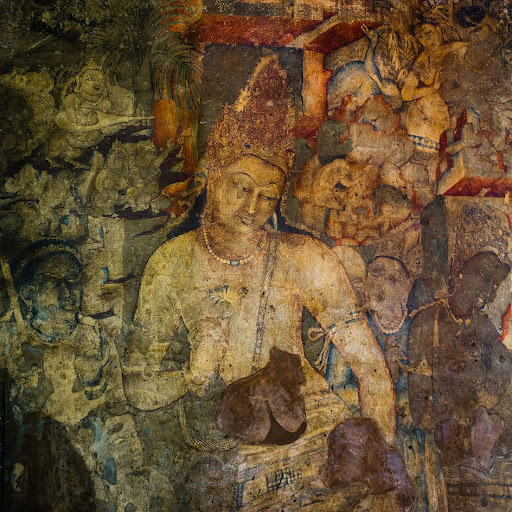
This is the Bodhisattva Padmapani, so called because he holds a lotus in his hand. This painting is from the Ajanta Caves. He is also known as Avalokitasvara. He is one of the most well known entities in Buddhism, after the Buddha himself, he is known as the Bodhisattva of Compassion. The name Avalokitasvara means “The one who looks down on the world and perceives its sounds”, ava+lokita+svara. But things are just beginning to get interesting. When Avalokitasvara travels to China along with Buddhism, he becomes a female bodhisattva, a divine mother instead of the dashing androgynous figure he cuts in this painting in the Ajanta caves. Scholars are not sure what prompted the Chinese to worship Avalokitasvara as a female figure, by all accounts, China was also a patriarchal society. Her new Mandarin Chinese name, Guanyin, does preserve the original meaning as “the one who perceives sounds, cries”. After Christianity arrived in China, Guanyin was naturally assimilated as the Mother Mary, full of grace. Guanyin also traveled to Japan, where she came to be called Kannon, and continued to be worshipped as a female bodhisattva. The Japanese camera company ‘Canon’ is named after her by the way. Did you think it was named after canon, a weapon of war, because you ‘shoot’ with a camera? No, obviously not, it’s because Kannon looks down on the world and hears its cries, which you can do with a camera. Damn.
What does this have to do with the mountain Podhigai? Avalokitasvara’s abode is a legendary mountain called Potala. The famous Potala Palace in Lhasa, Tibet was named after this legendary mountain. According to modern scholars, the Potala mountain of legend may have been in South India. It may have been the Podhigai mountain, which was also referred to as Potalaka in some sources. Some scholars even think that Podhigai, is a corrupted form of bodhi+ka, which means a place where Buddhists lived. According to Tamil Buddhist tradition, the sage Agastya learnt Tamil from Avalokitesvara, and taught it to the Tamilians. In the Shaivite tradition, it is Shiva who teaches Tamil to Agastya. Either way, the Podhigai hill is a culturally significant place for Tamilians, hailed as the birthplace of our language Tamil (yes I know that’s not how languages come about, but humour us) and this is why the DD Tamil channel was renamed to DD Podhigai. The mountain peak is no longer referred to by that name anymore, and it is called Agastyarkoodam, the place where the sage Agastya lived.
In 2023, I decided I had to summit the peak. My life was falling apart, all my support systems had crumbled … yeah I can’t get into all of that. This story is long enough as it is. I needed to visit the mountain after which I had named myself, to renew my will to live. I got the forest pass online from the Kerala forest department website for the two day trek, and summited the peak. At 1868 m above sea level, I could see the Peppara river in Kerala and the Tamraparni river in Tamil Nadu. Someone in our trekking group had a telephoto lens with his DSLR camera, and we glimpsed a herd of elephants on the lower hills. Was this where Avalokitasvara looked down on the world and heard its cries from? It was stunning. To the north and south of the peak, the Western Ghats ran like a long crease on the land.
There was an idol of Agastya on the Agastyarkoodam peak that pilgrims did puja to after they made the arduous journey to the peak. One of the forest officers who had accompanied us told us in Malayalam, “A professor from Chennai hired some men to bring the idol all the way up here and install it. The Agastya idol sits in Kerala, on this side of the border, but it faces Tamil Nadu to the east, with its back to Kerala”, she said rolling her eyes. I looked around feeling ashamed but none of the Malayalis were shocked. The forest officials probably didn’t care enough to point out that this idol alignment would be offensive, the idol was way up on the top of the peak and sparsely visited by people. Tamil exceptionalism was not a surprise to anyone. No, the problem wasn’t that we wouldn’t learn Hindi. The real problem was the way Tamilians treated speakers of other Dravidian languages. In moments like that, I wondered if we can’t be proud of our culture without putting down other people’s cultures.
I looked on at the great crease that was the Western Ghats from the peak, it was these mountains that had created our cultures. The mountain range stopped the rain clouds from the Southwest Monsoon, turning Kerala lush green, full of water bodies, leaving Tamil Nadu arid and drought-prone. That meant different livelihoods, different food habits. The mountains hindered migration across the lands, leading to an eventual split of the languages, and different cultures altogether. Humans in their hubris can think that their gods favoured them and created their culture for them, but it was this mountain I stood on that determined what lives we had lead and what lives we would continue to live. Did the short lives and gods of the humans matter to this mountain? Did it look on from above and listen to our cries?
After I returned to the base at Bonacaud, one of my new friends I had made on the trek said he needed to change before we left. We stopped at a forest ranger’s place, only his mother was at home. The mountain was still home to the Kanikkaran tribe, as it had been from long before the Buddhists or Shaivites or Christians had arrived here. The forest rangers were mostly from that tribe. We were all crammed in the old lady’s small home. The forest officer who had accompanied us told me, “She speaks Tamil, she is from Tamil Nadu.” She told the ranger’s mother too that I was a Tamilian. That was my cue to talk to her, and in Tamil. When I talked to her, she replied back in a language that sounded more like Malayalam. The realization was slow to arrive for me, I asked her “Do you always talk like this? It sounds like Malayalam to me because I speak Tamil, and it sounds like Tamil to our forest officer because she speaks Malayalam.” She smiled at me as if she were a small girl I had caught at her mischief with the crooked teeth that was left to her, “My family lived on the other side of the mountain, but we moved to this side when I was 16 and I learnt some Malayalam. I don’t remember Tamil that well, this is how I speak now.” My friend had changed into his fresh clothes, it was time to go. I said my goodbyes to her and left.
In the sutras, it is said that Avalokitasvara had a thousand eyes and a thousand arms, to see and help all the people who needed it. It is also said that they can take the form of a man, woman, child, a naga, a yaksha, a gandharva, an asura, a garuda, a kinnara, a mahoraga, any nonhuman being, as needed to help whoever needs it. I think what Avalokitasvara really represents is our capacity for compassion, that is present in everyone, regardless of who they are, beyond any labels. I like to think that my name is Podigai, to remember the mountains that shaped my life. I like to think that my heart is a place where Avalokitasvara can live, so that I can remember that it doesn’t matter what a person’s gender is or where they come from, or what their faith is, I can be compassionate towards myself, and all other beings.
“Oooo wow… that’s a lot… but I am probably just going to remember the Doordarshan TV channel when I say your name.” I guess that works too.